Responsibilities
Created and published a beginner tutorial series
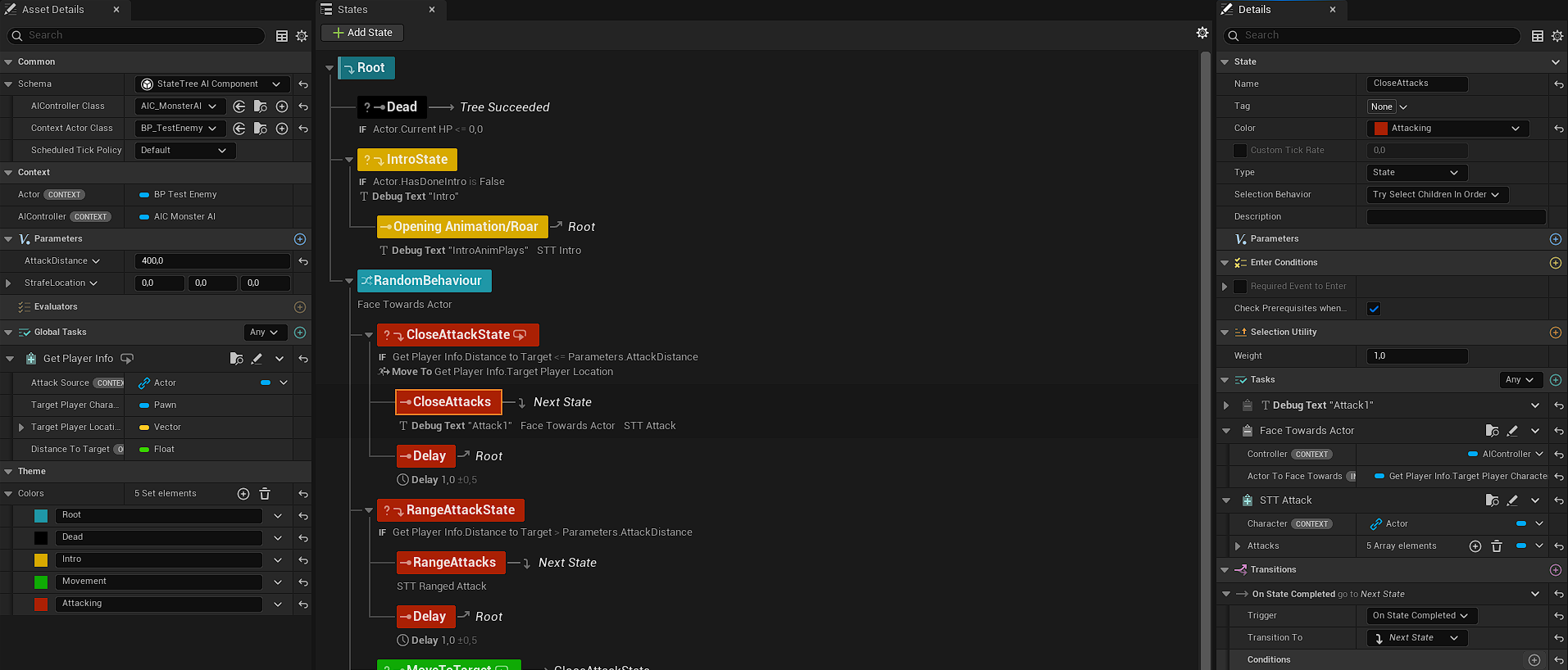
Designed and built a modular boss fight template
Researched and documented Unreal Engine StateTrees
The project
During my final year at Breda University of Applied Sciences, I chose to do a self-study project focused on StateTrees, Unreal Engine’s new AI system.
The project originally started as a boss fight template that I planned to publish on FAB. However, after completing the template, I realized the part I was most proud of was not the template itself, but the research behind it.
While researching, I fell in love with StateTrees and wanted to share what I had learned. The project pivoted from a template into a beginner’s guide to StateTrees, accompanied by a more in-depth document for anyone who wanted to dive deeper.
From Template to Tutorial
1. Researching StateTrees
At the start, I had a hard time grasping StateTrees. There was very little information available, and much of what I could find was already outdated as the system continued to evolve.
Because of this disconnect, I had to learn StateTrees from scratch. Along the way, I kept a document of everything I discovered so that, once I was done, I could share the resource I wish I had when I started.
It felt like learning a new engine without guidance. I initially tried to build a boss template the same way I would with Behaviour Trees, but it barely worked. That made it clear I needed to slow down and understand each component step by step.
This original version can be seen here →
Link empty Miro with just the RD in there here.
2. Creating the Template
After about five weeks of research, I felt I understood StateTrees well enough to start building the template.
In less than a week, I had a finished version. I even began adding extra features simply because I could: ranged attacks, AoE attacks, custom “Do Once” states, and more.
Everything made sense, and the workflow that StateTrees offered was incredibly intuitive. The template became everything I had planned and more.
At the same time, finishing it so quickly made it feel too small for a graduation project. I discussed this with my supervisor because it felt like something was missing.
I discussed these concerns with my supervisor and pitched the idea of turning the project into a beginner’s guide.
To make that possible, I broke the template down into sections and rebuilt it from scratch several times. This helped me find an order that introduced new concepts gradually, creating a coherent story without overwhelming the viewer.
This process also changed how I evaluated features.
For example, the ranged attack worked well, but the homing projectile required a lot of logic outside the StateTree and introduced no new StateTree concepts. That made it a poor fit for a beginner tutorial.
This realization became a guiding principle: every feature either had to teach a new part of StateTrees or be cut.
That approach helped shape the final tutorial and made room for important supporting systems such as; Environment Query System integration and StateTree debugging
3. Pivot
4. Creating the Guide
With the structure in place, I started recording the tutorial series.
This was my first time creating educational videos. I pressed record, started building, and explained my process as I went.
The first recordings had clear issues: I spoke too quickly and often glossed over important details. So I recorded them again and again, refining both the content and my presentation.
Through this process, I learned how to pace a tutorial and when to deliberately slow down so concepts have time to sink in.
One of the most valuable lessons was intentionally running into problems before solving them. Showing both the mistake and the fix helps viewers understand not just the solution, but also why the issue occurs.
Each episode improved, and with every recording I became more comfortable with the entire production process.
5. Publishing the Tutorial
The final result was a complete beginner’s guide to StateTrees, accompanied by an extensive written document for those who wanted to explore the system in more depth.
What started as a boss fight template became a resource designed to help other developers understand a powerful but under-researched feature of Unreal Engine.
By publishing both the videos and the supporting documentation, I was able to turn my research into a practical learning resource. The exact kind of resource I wish I had when I started.


Technical Designer
Sept 2025 - July 2026
Solo project
Unreal Engine 5.7, Miro, Perforce